
Acura, or Honda, NSX is one of those rare cars that probably don't need an introduction. For enthusiasts, it is more than just a well-known Japanese sports car. It is an extraordinary vehicle that helped redefine what a supercar could be. Developed to demonstrate the engineering capabilities of Honda and partly shaped thanks to feedback from Ayrton Senna, the original NSX proved that exotic performance does not necessarily have to come with punishing compromises. It showed the world that a supercar could be exciting, precise, and truly usable in everyday life. In this way, it prompted the established European competitors to rethink their own approach and helped usher in the modern era of supercars.
Because of this legacy, the idea of reworking the first-generation NSX may sound risky. It is not a car that many people consider to need improvement, at least not in the traditional sense. Its balance, purity, and design have made it an icon for decades. But Pininfarina and JAS Motorsport appear to take on this challenge with unusual confidence, and the result is a project that feels less like a typical restoration and more like a complete reinterpretation of NSX for a modern audience.
The project is called JAS Motorsport Tensei and was first introduced through a series of dark, teaser-style renders that hinted at something dramatic happening. Even in these early glimpses, the shape of the original NSX was still visible, but it was clear that this would not be a conservative update. Very recently, additional images and details showed just how extensive the transformation actually is, and the closer it gets to production, the more convincing it becomes.
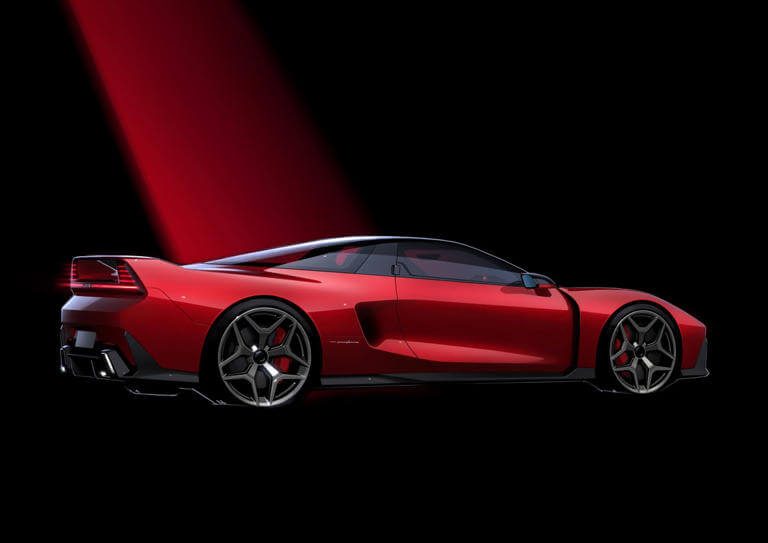
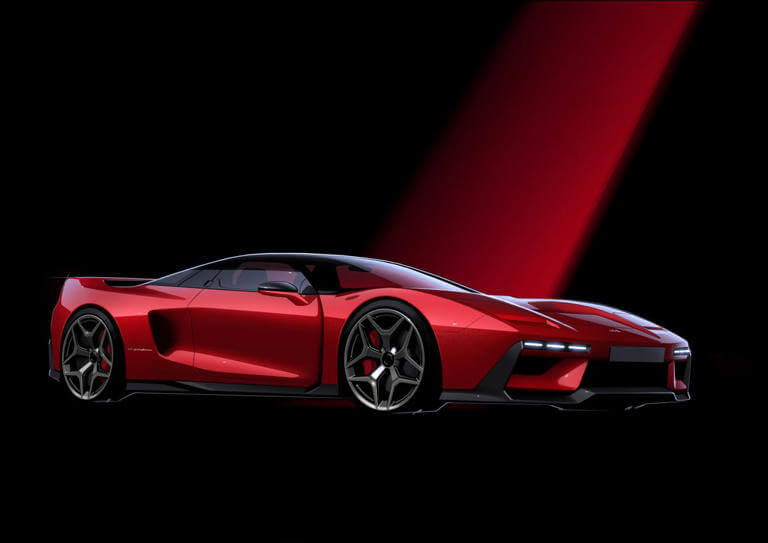
What makes Tensei so captivating is that it does not simply borrow the stylistic elements of the original NSX. It appears to fundamentally rethink the proportions, while simultaneously preserving the essence of the car. The wheelbase has been extended, the track has been widened, and the rear overhang has been shortened. Combined with a lower stance and larger wheels, these changes give the car a far more dramatic presence. It still reads immediately as a first-generation NSX, but now it carries the visual authority expected from modern exotica. In some ways, it looks like the idealized version of NSX that many enthusiasts remember from posters, magazines, and video games, only sharpened and modernized.
This may be the most impressive part of the redesign. Many interpretations of classic sports cars either remain too close to the original or go so far that they lose the soul of the original material. Tensei seems to aim for a more difficult balance. It respects the clean, low, flawless silhouette of the original NSX, but amplifies and refines it in a way that makes it feel more muscular, more exotic, and more relevant in today's supercar landscape. It does not try to replace the original. Instead, it presents a more extreme vision of how the original might look if it were rethought through a modern lens.
It is reported that the interior has also been reworked to meet modern expectations, although full images of the cabin have not yet been revealed. This leaves some mystery around how the project will handle one of the most important parts of the NSX experience. The original car was celebrated not only for its performance but also for its ergonomic simplicity and driver-focused design. A successful modern interpretation will need to preserve this usability, while simultaneously improving the materials, technology, and sense of occasion. If the exterior is any indication, the goal appears to be evolution, not rediscovery.
Mechanically, Tensei also appears determined to remain faithful to the spirit of NSX. Pininfarina confirmed that the car will use an atmospheric V6 engine, inspired by the original architecture of the NSX engine. This choice is significant. In a world increasingly dominated by turbochargers, hybridization and electrification, sticking with an atmospheric V6 engine implies a deliberate effort to preserve the immediacy, sound and character that made the original car so special. Althoughexact power figures are still not revealed, the promise is for high responsiveness, strong performance and an captivating driving experience, rather than simply a horsepower race.
Equally important is that the engine will be paired with a six-speed manual transmission. This decision reinforces the feeling that this is primarily a driver's car. It is a bold move in an era when many high-end cars have completely abandoned manual gears, and it fits perfectly into the analog spirit that continues to make the original NSX so beloved. Buyers will be able to choose configurations with left or right-hand drive, which signals that the project is intended to appeal to a truly international audience of enthusiasts and collectors.
Of course, exclusivity will likely be a key part of the package. Although official prices and production timelines have not yet been announced, a project of this kind will certainly sit firmly in the territory of high-end collectors. With the design heritage of Pininfarina, the racing experience of JAS Motorsport, customization options and the sheer rarity of the venture, Tensei is unlikely to be accessible in the conventional sense. It will almost certainly be one of those cars that will be seen at prestigious events, design showcases and gatherings of top-level enthusiasts, rather than on everyday roads.
And yet, what makes Tensei interesting goes beyond rarity or expected price. It represents an unusual form of homage to NSX. Rather than simply paying tribute to the original through restoration or imitation, it attempts to imagine how this legend would have evolved if reborn as a modern handcrafted exotic. It is a difficult task with a car as revered as NSX, but early results suggest that Pininfarina and JAS Motorsport may be on their way to finding something special.
For long-time enthusiasts, the original NSX remains untouchable in many ways. Its place in automotive history is secure and no reinterpretation is likely to replace what it achieved. But projects like Tensei do not need to replace the original to succeed.They simply need to pay tribute to its spirit, while offering a fresh perspective. From what has been revealed so far, this reborn NSX appears to do exactly that. It captures the beauty, balance and sense of purpose that made the first-generation car great, while simultaneously giving it a more dramatic and contemporary presence, which feels increasingly irresistible as production draws closer.